
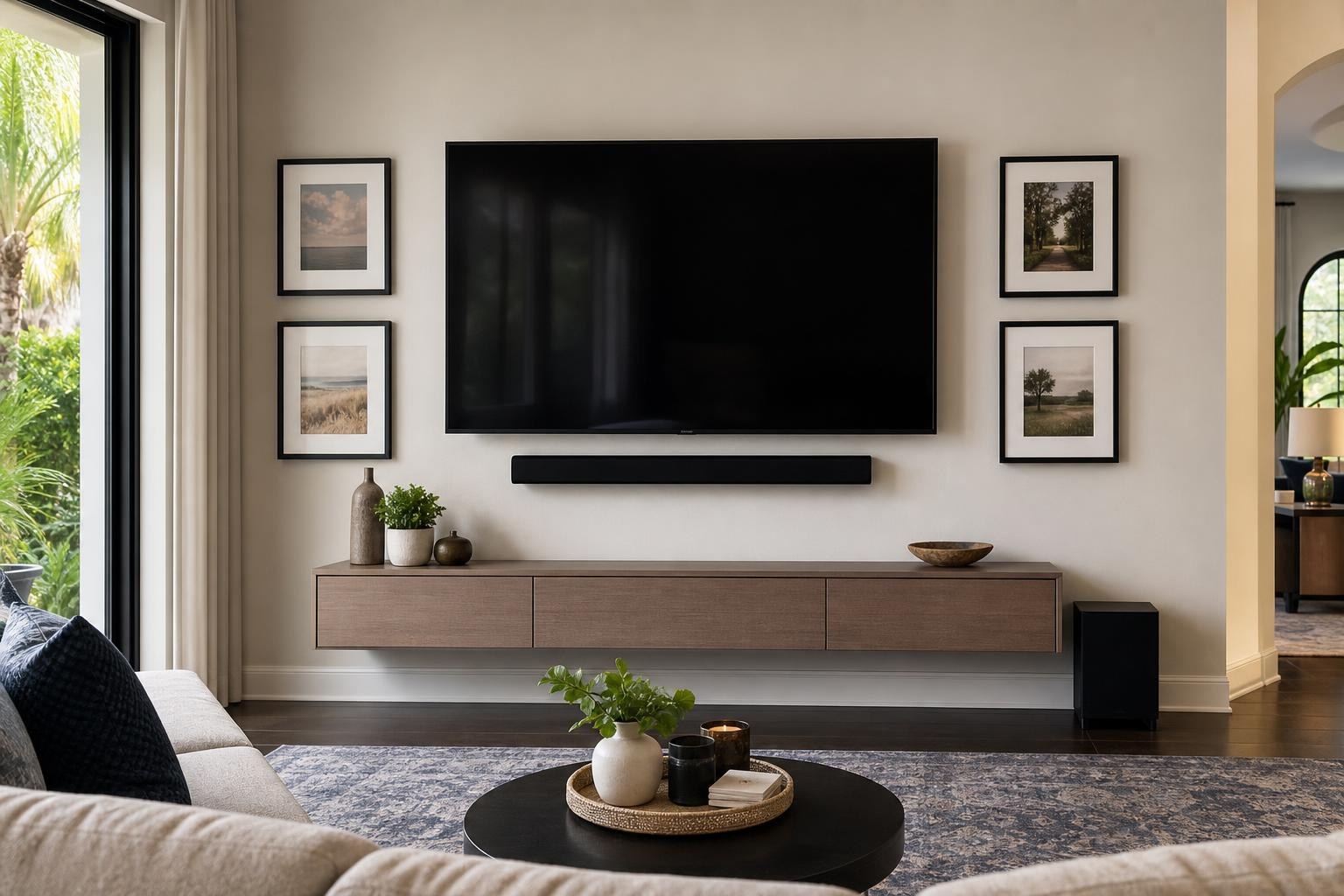
How to Arrange Pictures Around a Mounted TV Without Crowding the Wall
August 31, 2026
A mounted TV can leave the surrounding wall looking unfinished, especially when it sits in the middle of a large living room or bedroom wall. Adding pictures seems like the natural solution—until the frames compete with the screen, interfere with speakers, or make the entire arrangement feel cramped.
The goal is not to fill every open area. It is to make the TV, artwork, media furniture, and accessories look like parts of one intentional composition. Before hanging anything, consider how the wall looks when the TV is both on and off, how people move through the room, and which elements should command attention.
Treat the TV as the visual anchor
A television is usually the largest and darkest rectangle on the wall. Even when it is turned off, it carries more visual weight than a similarly sized piece of light-colored artwork. Pictures placed around it should support that anchor rather than fight it.
Begin by evaluating the entire wall instead of the empty patches immediately beside the screen. Note the width of the TV, the height and length of the furniture below it, and the position of any soundbar, floating shelf, or media device. A narrow arrangement clustered around a wide TV console can look undersized, while artwork that extends far beyond the furniture can make the composition feel disconnected.
In many rooms, the strongest arrangement relates to both the television and the furniture beneath it. This creates a visual zone with a clear beginning and end. It also prevents pictures from spreading across the wall simply because space is available.
Choose one layout style before selecting frame positions
Crowding often happens because pictures are added individually over time without an overall plan. Choosing a layout style first makes it easier to decide how many pieces the wall can comfortably hold.
- Balanced pairs: Matching or similarly sized pictures on each side of the TV create a calm, tailored appearance. This works well in formal living rooms and spaces with centered media furniture.
- Structured grid: Small groups of consistently sized frames can flank the TV without touching its visual space. Repeated frame dimensions help a larger collection feel organized.
- Relaxed asymmetry: Different frame sizes can create a collected look, but the visual weight should still feel balanced across the wall. One large frame may need two smaller pieces on the opposite side.
- Vertical side groupings: Pictures arranged above and below one another use narrow wall areas efficiently. This is useful when the TV occupies most of the horizontal space.
Avoid combining all four approaches on one entertainment wall. A grid on one side, a single large print on the other, and several small objects above the screen may each look appealing alone, but together they can become visually noisy.
Protect breathing room around the screen
The most important spacing is the open area immediately surrounding the TV. That negative space defines the screen and keeps nearby frames from looking as though they were squeezed into leftover gaps.
There is no universal spacing number that works for every television and frame collection. A large TV with substantial frames generally needs a broader visual buffer than a compact bedroom TV surrounded by small prints. Frame thickness, matting, wall color, and artwork contrast also affect how close the pieces appear.
Before installation, temporary paper templates can help homeowners judge the composition without committing to final positions. View the planned arrangement from the primary seating area and from the room entrance. If individual frames seem to merge with the TV at normal viewing distance, the composition likely needs more room.
Keep artwork clear of a mounted soundbar and avoid filling the narrow band between the television and media furniture. That area already contains multiple horizontal elements and can become crowded quickly.
Coordinate frame scale, color, and content
Pictures do not need to match perfectly, but they should share enough visual language to read as a group. Consistent frame colors, similar mat widths, or a controlled color palette can calm an arrangement that includes several sizes.
Large walls usually handle fewer substantial pieces better than a scattered collection of very small frames. Small artwork can still work, particularly in a grid, but it needs enough repetition and structure to hold its own beside the TV.
Artwork content matters as well. High-contrast prints, vivid family photographs, and ornate frames demand more attention than soft abstracts or neutral photography. If every piece is visually intense, the screen and art may compete. Selecting one dominant art piece and quieter supporting frames often creates a more comfortable result.
For an especially streamlined wall, consider whether every picture needs to surround the television. Some pieces may look better on an adjacent wall, where they can connect the entertainment area to the rest of the room without overloading its focal point.
Plan pictures with the soundbar, shelves, and media furniture
An entertainment wall is a system, not just a TV with decorations added afterward. A soundbar establishes another strong horizontal line. A floating entertainment center adds width and visual weight. Floating shelves introduce objects, shadows, and additional edges. Media cables can create unwanted lines that make even a carefully spaced gallery feel cluttered.
Consider these elements before finalizing picture locations:
- Whether a soundbar will mount beneath the television or sit on the furniture
- The finished height and width of an entertainment center
- Where streaming devices, Blu-ray players, and related components will be placed
- How visible media cables will be routed and organized
- Whether shelves need practical clearance for displayed objects
- How doors, drawers, and cabinet tops will be used
If the television installation is not yet complete, coordinating TV placement and picture hanging during the same planning process can prevent costly-looking compromises. TV Mounting Ocala provides TV mounting and related home entertainment services, including soundbar setup, wire and cable concealment, floating shelf mounting, media-furniture assembly, and picture hanging.
Common choices that make the wall feel crowded
Filling every symmetrical gap
Symmetry can be appealing, but it does not require an object in every open area. Leaving part of the wall empty often makes the intentional elements look more refined.
Placing frames too close to the TV corners
The corners of a screen naturally attract the eye. Frames positioned immediately outside them can look like accidental extensions of the television rather than separate decorative pieces.
Ignoring the view from outside the seating area
An arrangement may look balanced from the sofa yet feel lopsided from an adjoining kitchen, hallway, or entry. Important sightlines should be considered before positions are finalized.
Hanging art before assembling the furniture
Furniture dimensions on a product page do not always convey its finished visual presence. Assemble and position the entertainment center first whenever possible, then evaluate the available wall area. Professional media-furniture assembly can also be coordinated with TV setup and wall-mounted items.
Adding shelves without accounting for their contents
An empty floating shelf looks minimal. Once it holds framed photographs, plants, game accessories, or decorative objects, it becomes much busier. Plan for the completed display rather than the shelf alone.
When professional picture hanging makes sense
Professional help is especially useful when artwork must align precisely with an already mounted TV, when the frames are large or valuable, or when several wall-mounted elements need to share limited space. Different wall surfaces, frame hardware, weights, and dimensions can also affect how a piece should be positioned and supported.
A coordinated appointment can address the overall appearance rather than treating each item as an isolated task. This may include evaluating the TV position, mounting a soundbar, organizing media cables, assembling or installing media furniture, hanging pictures or mirrors, mounting floating shelves, and anchoring appropriate furniture.
Before the appointment, gather the frames and decorative items you are considering, confirm which furniture will stay in the room, and identify the main seating position. It is also helpful to have the TV, soundbar, streaming devices, remotes, and connection cables available if home entertainment setup is part of the project.
Create a finished entertainment wall without overfilling it
The best picture arrangement does not call attention to how many frames fit around a mounted TV. It makes the whole wall feel proportionate, functional, and complete. Start with the television and furniture as the primary structure, preserve open space around the screen, and select one clear layout style.
TV Mounting Ocala serves homeowners and property residents across Marion, Orange, Alachua, Sumter, and Citrus counties. If you want your television, pictures, soundbar, shelves, cables, and media furniture planned as one cohesive installation, get an instant online quote and book TV Mounting Ocala.
Ready to Get the Setup Off Your To-Do List?
Whether you are planning a new TV, soundbar, streaming setup, floating entertainment center, media furniture, pictures, mirrors, shelves, or another related mounting project, TV Mounting Ocala can help you turn the plan into a clean finished setup.
TV Mounting Ocala
(352) 462-1913
Project details, equipment, wall conditions, compatibility, availability, and final pricing can vary. Confirm your exact scope and quote before booking.
Related local services: Furniture Assembly Ocala · Furniture Assembly Orlando
Serving another priority local market: TV Mounting The Villages.