
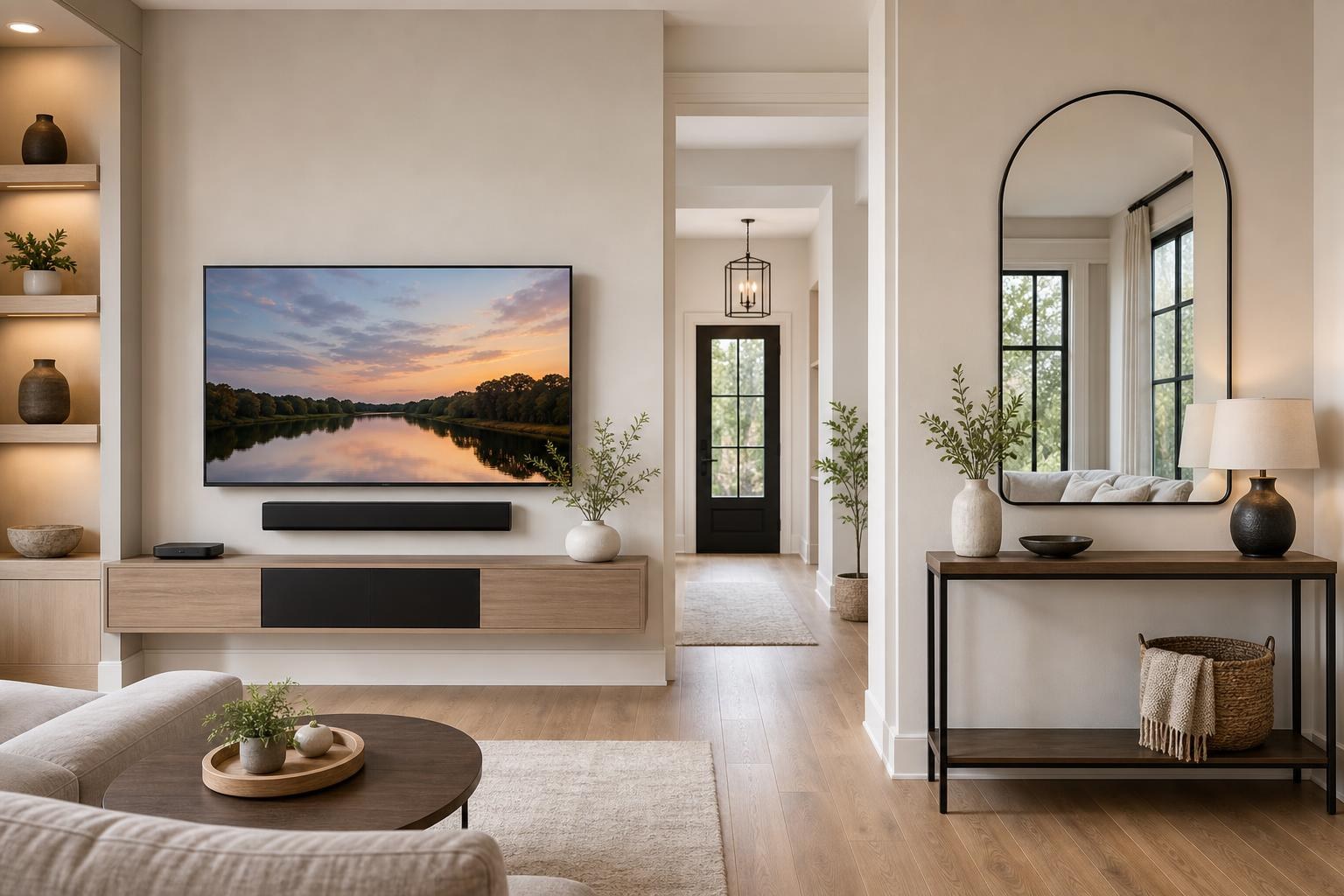
Mirror Placement Near a Media Console: Reflections, Balance, and TV-Wall Planning
September 22, 2026
A mirror may look perfect above a console in a showroom, yet feel distracting once it is placed in a real home. The difference often has little to do with the mirror itself. What matters is what it reflects, how it relates to nearby furniture, and whether it competes with a mounted TV or another focal point.
This is especially important in open Central Florida homes, where an entry area may share sightlines with the living room and media wall. Before hanging the mirror, it helps to evaluate the entire space rather than treating an empty section of wall as an isolated decorating opportunity.
Begin With What the Mirror Will Reflect
The most overlooked placement question is not what sits below the mirror. It is what appears inside the mirror from the room’s normal viewing positions.
A well-placed mirror might reflect a window, artwork, a dining area, or an attractive part of the room. A poorly placed one may reflect a television screen, a busy device shelf, visible media cables, a hallway door, or everyday clutter on the opposite side of the space.
Walk through the viewpoints that matter before finalizing a location. Consider what the mirror will show from:
- The main entrance to the room
- The sofa or primary TV-viewing seats
- An adjacent kitchen or dining area
- A hallway that opens toward the console
- The front door, if the mirror is part of an entry arrangement
Reflections also change during the day. A mirror that appears calm in the evening could catch strong daylight or create distracting brightness during afternoon television viewing. The goal is not to eliminate every reflection, but to avoid making glare or the TV screen more visually prominent.
A Media Console and an Entry Table Create Different Priorities
Although both pieces may be long, low cabinets, they usually serve different purposes.
Above an entry table
An entry mirror should feel convenient when someone enters or leaves while still contributing to the room’s overall composition. Placement needs to account for lamps, bowls, framed photos, decorative branches, and other objects that may occupy the tabletop. If the mirror is too low or visually cramped, normal styling can cover part of its reflective area.
Furniture stability also deserves attention in an active entryway. If the table is narrow, top-heavy, or likely to be bumped, professional mounting and furniture-related services can address the mirror and appropriate furniture anchoring as part of a more complete plan.
Near a media console
A mirror near media furniture must coexist with the screen, soundbar, speakers, streaming devices, and cable organization. If the console sits directly below a mounted TV, adding a mirror above that same piece is usually not practical. The more common question is whether a mirror should go beside the TV, above an adjacent cabinet, or on a nearby perpendicular wall.
In that setting, the television already acts as a large dark rectangle and a strong visual focal point. A mirror with a similarly bold frame can create competition rather than balance. Shape, scale, frame color, and separation all affect whether the wall looks intentionally composed or simply crowded.
Treat the Mirror and Furniture as One Composition
Mirror placement works best when it relates clearly to the furniture beneath it. That relationship does not always require exact centering, but an offset arrangement should look deliberate and have a reason, such as making room for a tall lamp or balancing another item on the wall.
Consider the visual width of the mirror as well as its actual dimensions. A thick black frame carries more visual weight than a narrow metallic edge. An arched mirror can feel lighter at the top than a rectangular mirror of similar size. A cluster of small mirrors introduces more lines and reflections than one larger piece.
The furniture matters too. A floating media console creates a different composition from a console with legs, and a slim entry table may not visually support an oversized mirror. Planning both pieces together helps avoid a top-heavy or undersized appearance.
Do Not Let the Mirror Compete With the TV
When a mirror and television can be seen at the same time, decide which one should be the room’s primary focal point. In most living rooms, the screen and entertainment wall naturally take that role.
A nearby mirror can support the design by reflecting light or filling a secondary wall, but it should not make the media area feel visually restless. Common warning signs include:
- The mirror reflects moving images from the TV into another seating area.
- Two large dark frames appear crowded together.
- The mirror interrupts the intended alignment of the TV, soundbar, and console.
- A reflected window increases glare around the screen.
- The mirror blocks a practical location for a speaker, shelf, or media device.
If the entertainment wall is still being planned, choose TV, soundbar, console, shelf, and mirror locations as one system. This is more effective than mounting each piece separately and trying to resolve conflicts afterward.
Account for Doors, Walkways, and Everyday Movement
An entry table often sits near a door, coat area, bench, or busy walkway. Media consoles may be close to sliding doors, lanai access, or an open path between living and dining spaces. These conditions affect more than appearance.
A mirror should not feel vulnerable to door movement, bags, furniture corners, or regular foot traffic. Its edges also should not project awkwardly beyond the furniture in a way that makes the arrangement feel exposed. Large or heavy mirrors require particular care because their size can make small placement errors more obvious.
Before booking, note nearby doors and measure the mirror and furniture. Photos showing the full wall and surrounding room are also useful when discussing the intended location.
Plan Around the Finished Furniture Position
Do not finalize a mirror position based on furniture that is temporarily pushed against a wall or waiting to be assembled. The console or entry piece should first be in its intended location, with doors and drawers opening normally and enough room for the way the space will be used.
For a media console, also consider whether the furniture will hold a soundbar, game system, Blu-ray player, streaming device, or decorative objects. Media-cable routing and device access can affect where shelves and adjacent wall décor belong. TV Mounting Ocala can assist with entertainment-center assembly, floating entertainment-center installation, device hookup, streaming setup, soundbar setup, and media-cable organization when those needs are part of the same room plan.
What to Share Before a Professional Mirror-Hanging Appointment
A clear description of the room helps identify placement conflicts before installation begins. Useful information includes the mirror’s dimensions, approximate weight if known, frame style, existing hanging hardware, furniture dimensions, and photos of the full wall.
If a television, soundbar, shelf, or floating console is also planned, mention those items at the same time. Combining related wall decisions can produce cleaner alignment and reduce the chance that one installation limits another.
Unusual wall finishes, oversized mirrors, and mirrors positioned near corners or doorways should also be identified when requesting service. If you are uncertain whether the proposed arrangement falls within the company’s scope, you can contact TV Mounting Ocala with details about the mirror and room.
A Better Result Comes From Planning the Whole View
The right mirror location is not determined by one universal measurement. It depends on the furniture below it, the room’s important sightlines, reflected light, nearby entertainment equipment, and how people move through the space.
That is why mirror hanging near a media console or entry table is often best approached as part of the finished room—not as a separate task. Thoughtful placement can make the furniture feel grounded, keep the TV wall visually organized, and ensure the reflection adds something attractive rather than another distraction.
TV Mounting Ocala serves homeowners and property residents across Marion, Orange, Alachua, Sumter, and Citrus counties with mirror hanging, TV mounting, media-furniture assembly, floating shelf installation, soundbar setup, and related home-entertainment services. To plan your project, get an instant online quote and book based on the services your room needs.
Ready to Get the Setup Off Your To-Do List?
Whether you are planning a new TV, soundbar, streaming setup, floating entertainment center, media furniture, pictures, mirrors, shelves, or another related mounting project, TV Mounting Ocala can help you turn the plan into a clean finished setup.
TV Mounting Ocala
(352) 462-1913
Project details, equipment, wall conditions, compatibility, availability, and final pricing can vary. Confirm your exact scope and quote before booking.
Related local services: Furniture Assembly Ocala