
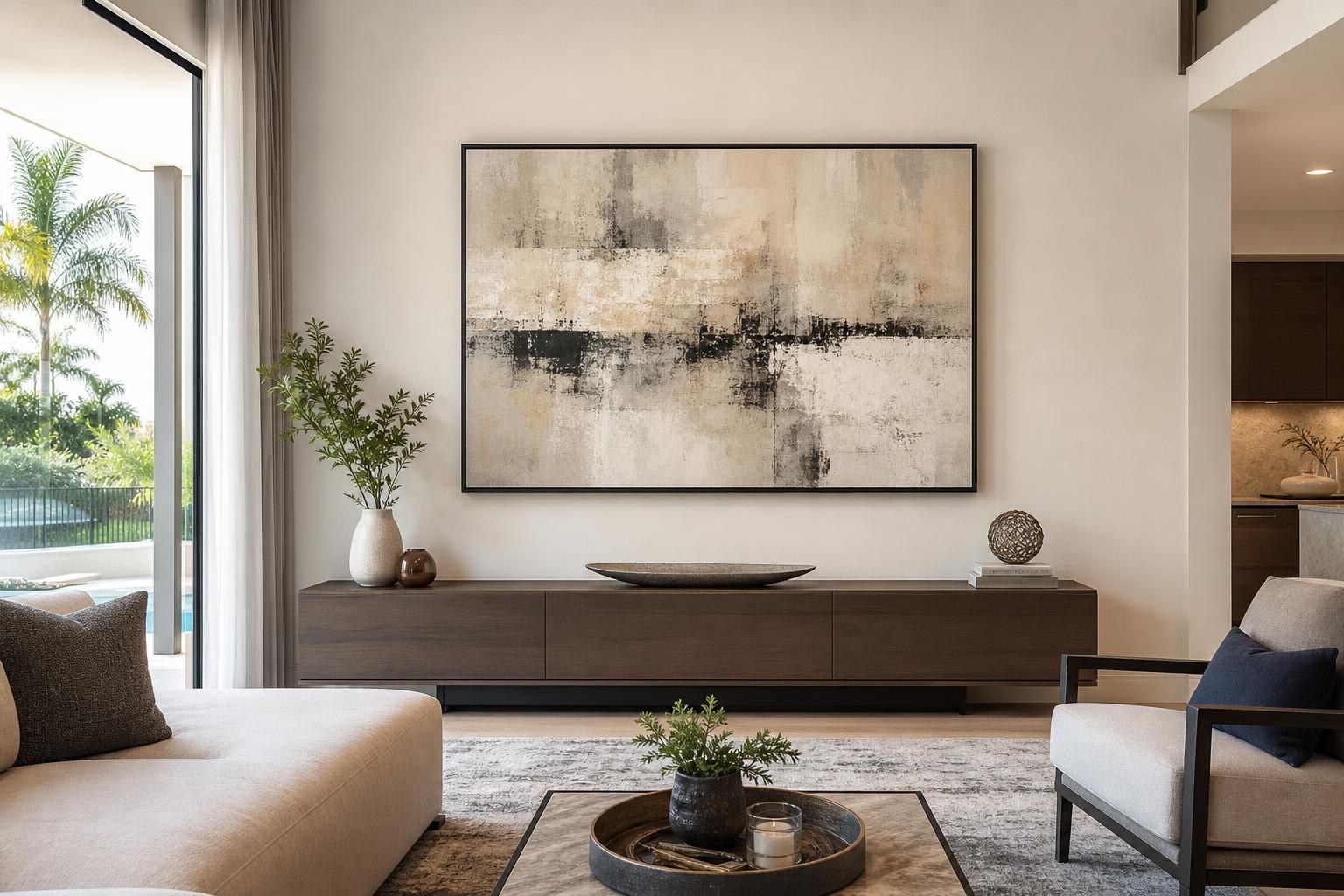
Hanging Large or Heavy Wall Art: What to Plan Before Installation
September 17, 2026
An oversized painting, framed print, sculptural piece, or multi-panel artwork can transform a room. It can also create an immediate planning problem: where should it hang, how should it relate to the furniture, and what mounting approach is appropriate for its size and weight?
These decisions are closely connected. A piece can be securely mounted yet still look awkward because it is too high, visually off-center, or poorly scaled for the wall. Conversely, a beautiful layout does not help if the mounting method is mismatched to the artwork, hanging hardware, or wall surface.
Before booking picture hanging for large or heavy wall art, consider the complete installation—not just the point where a hook or mounting component meets the wall.
Why Large Artwork Requires More Than a Center Measurement
Small frames allow some flexibility. Oversized art dominates more of the wall, so minor placement issues become much easier to notice. A piece that is slightly high or shifted away from the room’s visual center can make an otherwise polished space feel unsettled.
The correct position may not be the mathematical center of the wall. Layout often depends on what sits below or around the artwork, including a sofa, console, bed, dining table, fireplace, doorway, or mounted TV.
For example, artwork above a sofa generally needs to relate to the sofa rather than the full wall. If the sofa is intentionally positioned off-center because of a doorway or traffic path, centering the art on the wall could separate it visually from the furniture grouping.
Before installation, identify the room element that should anchor the composition. That is often more useful than treating every available wall as an isolated rectangle.
Scale Changes How the Room Feels
Large wall art works best when it feels substantial without overwhelming nearby furniture. The goal is visual balance: the piece should look intentionally selected for that location rather than squeezed into the available area or floating in too much empty space.
Important scale questions include:
- Does the artwork feel proportionate to the sofa, bed, console, or other furniture below it?
- Is there enough breathing room around the frame or sculptural edges?
- Will the art compete with a television, mirror, shelving, or architectural feature?
- Does the piece still look balanced from the room’s main entrance and primary seating area?
- Could a future furniture change make the chosen placement look misplaced?
Temporary floor placement can help homeowners evaluate scale before an appointment. Leaning the protected piece near its intended wall allows you to view it from several angles without committing to a final height. For very large pieces, marking the approximate outer dimensions with removable painter-friendly material can make the visual impact easier to judge.
Artwork Weight Is Only One Part of the Mounting Decision
Homeowners often focus on the total weight of the art, but the mounting method also depends on how that weight is distributed and how the piece was designed to hang.
A wide frame suspended from two attachment points behaves differently from a narrow object using a single centered hanger. A deep shadow box, heavy mirror-style frame, carved wall panel, or metal artwork may project farther from the wall and place different demands on its mounting components.
The installer should be able to inspect both the wall and the back of the piece. Relevant details include the frame condition, manufacturer-installed hanging hardware, number and position of attachment points, overall dimensions, and whether the piece needs to sit flush or project away from the surface.
Do not assume attached wire or small frame hardware is suitable simply because it came with the artwork. Large pieces may have been shipped with hardware intended for display, transport, or a wall condition different from the one in your home.
Wall Type Affects the Installation Plan
Drywall, masonry, brick, wood paneling, and other finished wall surfaces do not accept mounting components in the same way. The wall finish may also influence placement. Mortar lines, decorative trim, panel seams, or an uneven textured surface can affect how level and flush the artwork appears.
This is one reason it helps to describe the wall when requesting a quote. Photos of the intended location and the back of the artwork can provide useful context. The final approach should be selected after considering the actual wall, the piece, and its hanging hardware together.
Special care may also be needed with fragile, valuable, unusually shaped, or irreplaceable pieces. If artwork has specific handling or installation instructions from the artist, gallery, or manufacturer, keep that information available for the appointment.
Placement Above Furniture Needs Practical Clearance
Art above furniture should look connected to the furniture grouping without feeling crowded. The right spacing varies with the height of the furniture, artwork dimensions, ceiling height, and what happens on the furniture surface.
A console may hold lamps, speakers, decorative objects, or media devices. A bedroom dresser may have a jewelry box or tall accessories. A sofa can have high cushions that visually reduce the gap beneath the artwork. Planning around these real objects creates a more finished result than applying one universal height rule.
Also consider daily movement. Art near a bench, chair, narrow hallway, or frequently used cabinet door should not project into a path where it can be bumped. In family rooms, the layout may need to account for active areas and furniture that shifts during normal use.
Large Art Near a Mounted TV Should Support the Media Wall
Heavy artwork near a television needs an especially deliberate layout. The TV is already a strong dark rectangle, and adding another large visual object can make the wall feel crowded or uneven.
Rather than filling every open section, decide whether the artwork should balance the TV, frame the entertainment zone, or belong to a separate furniture grouping. Matching the TV and art edge-to-edge is not always necessary. Their visual weights, frame colors, and surrounding negative space matter just as much as exact dimensions.
If the room includes a soundbar, floating entertainment center, or floating shelves, plan all components as one composition. TV Mounting Ocala’s mounting and home entertainment services can help coordinate pictures and related wall-mounted items with the broader entertainment layout.
Common Layout Problems to Resolve Before Hanging
The art is centered on the wrong reference point
A wall may be wider than the furniture grouping, especially in open-concept rooms. Centering art on the entire wall can leave it looking disconnected from the sofa, console, or dining arrangement it is meant to complement.
The piece is placed too high
Homeowners may raise large art to fill vertical space or clear furniture. From normal seating and standing positions, however, an elevated piece can appear to float. Ceiling height alone should not determine placement.
The installation ignores frame depth
Deep frames and sculptural pieces affect shadows, side views, and clearance. Their projection should be considered in narrow rooms, hallways, and locations near doors or furniture corners.
A gallery arrangement is treated as separate pieces
Multi-panel artwork and grouped frames should be planned as a single overall composition. Inconsistent gaps or drifting alignment become more obvious as the arrangement expands.
What to Prepare Before Your Picture-Hanging Appointment
A little preparation can make the placement discussion more productive without requiring you to determine the mounting method yourself. Before the appointment:
- Measure the artwork’s overall width and height.
- Provide an accurate weight if it is available from the maker or retailer.
- Photograph the front, back, frame edges, and attached hanging hardware.
- Share a wide photo of the wall, nearby furniture, and surrounding room.
- Note whether the furniture is staying in its current position.
- Identify nearby doors, walkways, shelves, TVs, soundbars, or other wall décor.
- Keep any manufacturer or gallery installation guidance available.
If you are still deciding between two walls, mention both. Comparing sightlines, furniture relationships, and available space may reveal that one location is clearly better suited to the piece.
Professional Picture Hanging Helps the Whole Room Feel Intentional
Professional installation is not only about getting a large piece onto the wall. It brings together layout, level alignment, mounting compatibility, spacing, and the way the artwork relates to the room.
TV Mounting Ocala handles picture and mirror hanging along with TV mounting, floating shelf mounting, floating entertainment-center installation, media-furniture assembly, and related wall-mounted items. This can be particularly useful when several elements need to align on one feature wall or throughout a newly furnished home.
Homeowners in Marion, Orange, Alachua, Sumter, and Citrus counties can start by sharing details about the artwork and intended location. Visit the TV Mounting Ocala website to review the service scope, or get an instant online quote when you are ready to plan the installation. You can also call (352) 462-1913.
Ready to Get the Setup Off Your To-Do List?
Whether you are planning a new TV, soundbar, streaming setup, floating entertainment center, media furniture, pictures, mirrors, shelves, or another related mounting project, TV Mounting Ocala can help you turn the plan into a clean finished setup.
TV Mounting Ocala
(352) 462-1913
Project details, equipment, wall conditions, compatibility, availability, and final pricing can vary. Confirm your exact scope and quote before booking.
Related local services: Furniture Assembly Ocala
Serving another priority local market: TV Mounting The Villages.