
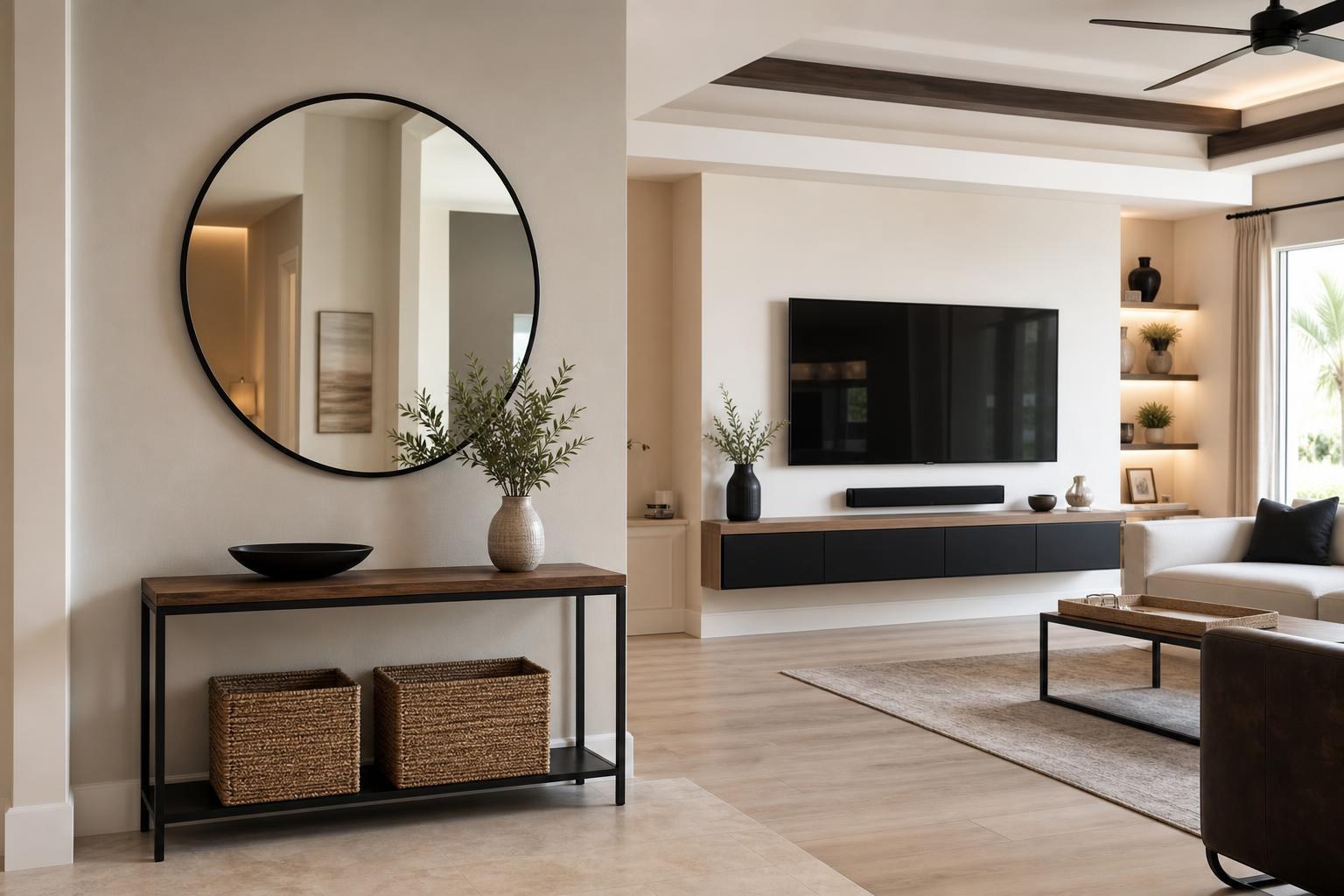
How High Should a Mirror Hang Above a Media Console or Entry Table?
September 16, 2026
A mirror can look perfectly sized in a showroom and still feel awkward once it is placed above a media console or entry table. It may sit too high, reflect an unwanted view, compete with a nearby TV, or leave too little room for the objects people actually use on the furniture.
The best placement comes from treating the mirror and furniture as one visual arrangement. Before anyone mounts the mirror, consider its dimensions, the console height, the surrounding wall, what the mirror will reflect, and how the furniture functions from day to day.
Start With the Furniture, Not the Wall
A common mistake is centering a mirror on the available wall without considering the furniture below it. In most rooms, the mirror should feel connected to the console or table rather than floating independently above it.
The furniture establishes the visual center of the arrangement. If a console is intentionally positioned off-center because of a doorway, walkway, or nearby TV, the mirror will usually look more deliberate when aligned with the furniture—not the entire wall.
Furniture height matters as well. A low media console creates more open wall space than a tall entry cabinet. The same mirror can therefore need a different hanging height in each setting.
How Much Space Should Be Between the Mirror and Console?
There is no single gap that works for every combination, but roughly 6 to 10 inches between the top of the furniture and the bottom of the mirror is a useful visual starting point. The final position may need to change based on the mirror’s frame, console height, ceiling height, and objects placed on the surface.
A narrow gap tends to make the mirror and furniture read as a coordinated unit. Too much separation can make the mirror appear disconnected. Too little room may crowd lamps, framed photos, speakers, decorative objects, or items routinely placed on an entry table.
Before selecting the height, decide what will permanently remain on the furniture. A tall lamp or vase may need breathing room, while a low-profile media console with only a streaming device or remote tray can support a simpler arrangement.
Should the Mirror Be Centered Over the Furniture?
Centering is usually the cleanest option, especially with a rectangular console and a single large mirror. However, the frame—not just the reflective glass—should be used when evaluating the visual balance.
Intentional asymmetry can work when the entire arrangement supports it. For example, an offset round mirror may balance a tall lamp or grouped décor on the opposite side. Without that visual counterweight, an off-center mirror can look like a measuring mistake.
Also check how the console relates to nearby features. A mirror centered over the furniture may still feel wrong if the overall arrangement collides visually with a mounted TV, doorway trim, floating shelf, or adjacent artwork.
Choose a Mirror Size That Matches the Console
A mirror that is too narrow can look undersized, while one wider than the furniture may make the arrangement feel top-heavy. Many balanced installations use a mirror that is visibly narrower than the console, although shape and frame weight influence the result.
A thick, dark frame carries more visual weight than a thin metallic frame of the same dimensions. Likewise, a large round mirror may feel substantial even though it does not fill the upper corners of the space.
Evaluate these factors together:
- The full outside dimensions of the mirror frame
- The width and height of the console or entry table
- The usable wall area around the arrangement
- The height of lamps, speakers, décor, and everyday items
- The visual weight of nearby TVs, shelves, pictures, or doorways
If the furniture has not been assembled or positioned yet, complete that decision first. Mirror placement based on an estimated console height can easily end up looking too high or too low after the furniture is in place.
Check What the Mirror Will Reflect
A mirror’s position determines more than how it looks on its own wall. It also frames part of the room across from it. Before choosing the final location, view the proposed mirror area from the main doorway, seating positions, and normal walking paths.
Ideally, the mirror reflects an intentional part of the home, such as natural light, artwork, or an open portion of the room. Reflections of cluttered device shelves, a hallway corner, or the back of a TV can make an otherwise attractive installation feel less polished.
Central Florida homes often receive strong daylight through large windows and sliding doors. A mirror that faces this light may brighten an entry or living area, but it can also create distracting glare at particular times of day. That matters even more near a media space where reflected light could compete with the TV screen.
Placement Near a TV Requires Extra Planning
A mirror and mounted TV can coexist, but both are visually dominant rectangles. If they are too close, nearly the same size, or mounted at unrelated heights, the wall may feel crowded.
For a media console positioned directly under a TV, the screen should generally remain the focal point. Adding a mirror immediately beside or above the same console may blur the purpose of the wall. A mirror often works better on an adjacent wall, over separate furniture, or as part of a clearly defined entry zone.
Check whether the mirror will reflect the TV from a common seat. Moving images and bright screens appearing in the reflection can be distracting. The mirror also should not interfere with soundbar placement, device access, media-cable organization, or clearance around floating entertainment furniture.
If the room includes several components, TV Mounting Ocala can help plan them as one composition through its mounting and home entertainment services. This can include TV and soundbar mounting, media-furniture assembly, cable organization, floating shelves, and mirror or picture hanging.
Entry Furniture Has Different Priorities
An entry mirror is often used for a quick appearance check, so practical viewing height matters more than it might above purely decorative furniture. However, placing the mirror’s center at a generic eye-level measurement can still create a poor relationship with the table below.
Consider the range of people using the mirror, the depth of the entry furniture, and how far someone can comfortably stand from it. A very narrow hallway may provide only a close view, while an open foyer allows the mirror to be appreciated as part of the larger room.
Door movement and traffic patterns also matter. Frames should not feel cramped beside an opening, and the arrangement should not project awkwardly into a busy path. If the entry table needs furniture anchoring, that can be planned alongside assembly and mirror placement rather than treated as an unrelated task.
Why Mirror Weight and Wall Conditions Matter
Large mirrors require more planning than lightweight wall décor. Frame construction, overall weight, mounting points, wall conditions, and nearby obstacles all affect the appropriate installation approach. Manufacturer-provided hardware may also vary considerably between mirrors.
This is where professional hanging becomes especially useful. A placement can be reviewed for both appearance and practical support before the mirror is committed to the wall. It also reduces the chance of discovering too late that the preferred visual position conflicts with the mirror’s mounting configuration.
Have the mirror available for evaluation and retain any included mounting components or manufacturer information. If the console is new, assemble and position it first—or arrange for media-furniture assembly as part of the same project.
What to Decide Before Booking Mirror Hanging
You do not need to determine the final mounting point in advance, but a few decisions make the appointment more productive. Identify the preferred furniture location, decide what will sit on top, and note any nearby TV, soundbar, shelf, artwork, doorway, or high-traffic path.
It also helps to consider whether the room needs related finishing work. A new media console may need assembly, the TV may need centering with the furniture, or visible media cables may need cleaner routing and organization. Planning these pieces together produces a more cohesive result than setting each item independently.
TV Mounting Ocala serves homeowners and property residents across Marion, Orange, Alachua, Sumter, and Citrus counties. For help hanging a mirror near entry furniture or coordinating it with a TV and media console, contact TV Mounting Ocala with details about the mirror, furniture, and room. You can also get an instant online quote and book the relevant mounting or assembly options.
Ready to Get the Setup Off Your To-Do List?
Whether you are planning a new TV, soundbar, streaming setup, floating entertainment center, media furniture, pictures, mirrors, shelves, or another related mounting project, TV Mounting Ocala can help you turn the plan into a clean finished setup.
TV Mounting Ocala
(352) 462-1913
Project details, equipment, wall conditions, compatibility, availability, and final pricing can vary. Confirm your exact scope and quote before booking.
Related local services: Furniture Assembly Ocala
Serving another priority local market: TV Mounting The Villages.