
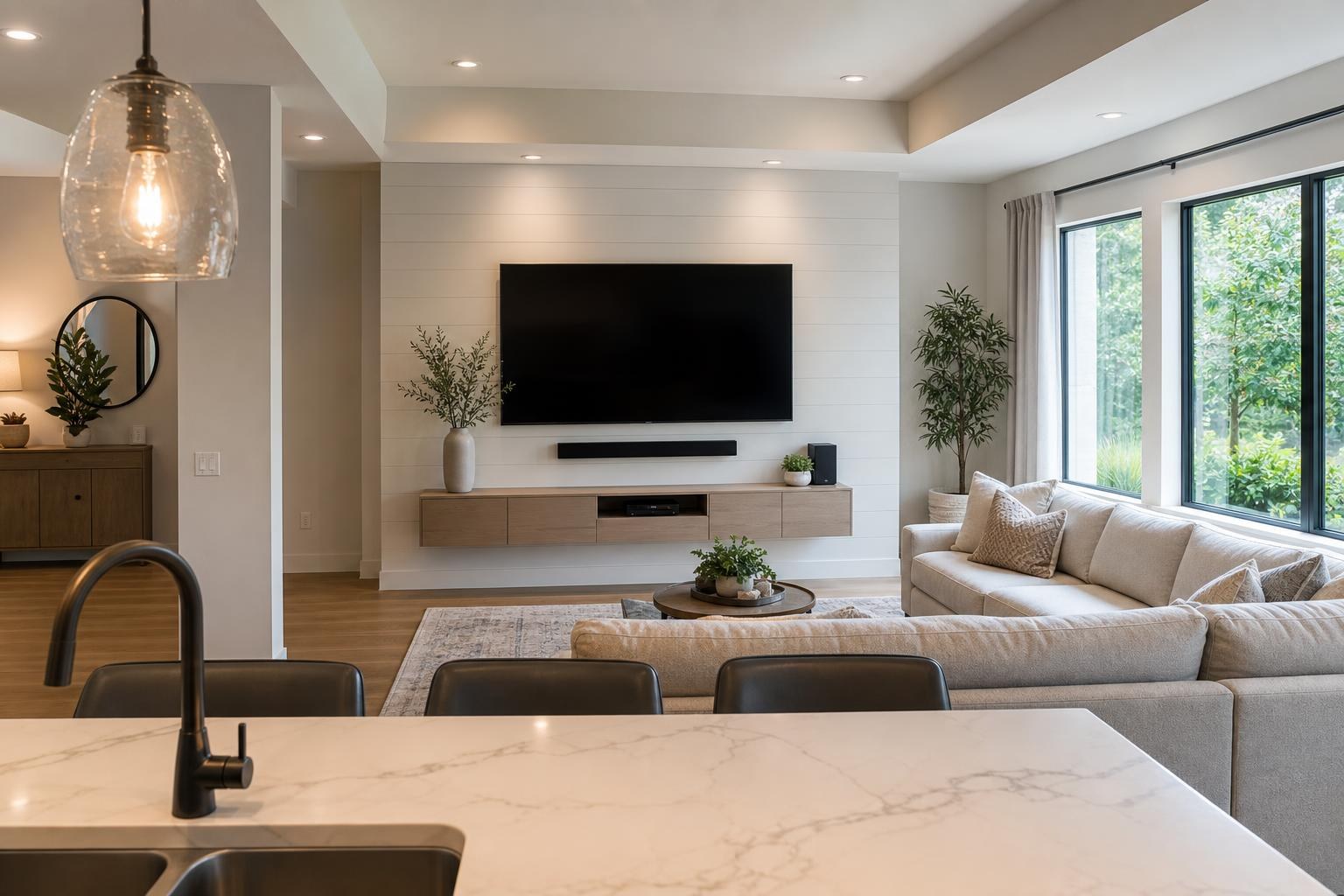
Where Should You Mount a TV in an Open-Concept Living Room?
September 4, 2026
The best TV wall in an open-concept living room is not always the most obvious one. A wall may look perfect from the main sofa but leave everyone at the kitchen island watching from an uncomfortable angle. Another location may improve visibility while creating glare, crowding a walkway, or forcing the entertainment furniture into an awkward position.
Before booking a TV mounting service, it helps to evaluate the room as one connected space. The TV, seating, soundbar, media furniture, windows, walkways, and viewing habits should work together rather than competing for attention.
Start With the Room’s Primary Viewing Zone
Open-concept living spaces often include several places where someone might watch: a sofa, sectional, accent chair, dining table, or kitchen island. Trying to give every seat a perfectly centered view can lead to poor placement for the seats used most often.
Instead, identify the primary viewing zone. This is usually the sofa or sectional where people settle in for movies, sports, gaming, or evening streaming. The TV should feel naturally oriented toward that area before secondary viewing angles are considered.
Then look at the secondary zones. Can someone in the kitchen glance at the screen without looking sharply over a shoulder? Does an accent chair have a reasonable view? Is the TV still visible when people are seated rather than standing?
This priority-based approach helps prevent a common mistake: compromising the everyday sofa experience just to make the screen visible from every corner of the floor plan.
Evaluate Each Candidate Wall From More Than One Seat
A TV can appear centered when viewed from the middle of the room yet feel noticeably misplaced from the furniture people actually use. Before deciding on a wall, sit in the primary and secondary viewing positions and consider how the screen would relate to each one.
- Viewing direction: Notice whether people can face the screen naturally or must keep their heads turned.
- Screen visibility: Consider whether tall furniture, decorative objects, or passing foot traffic could interrupt the view.
- Room balance: Check whether the TV location visually anchors the living area or makes the entire layout feel pulled to one side.
- Traffic flow: Avoid making a major walkway pass directly between the primary seating and screen.
- Adjoining spaces: Decide whether casual visibility from the kitchen or dining area is important for your household.
If two walls appear equally practical, the better option is often the one that gives the main seating a straightforward view while reducing glare and preserving a comfortable path through the room.
Do Not Let Architectural Center Dictate TV Center
In an open floor plan, the center of a wall may not be the center of the living zone. One side of the wall might align with the dining area, while the other belongs visually to the seating arrangement. Mounting the TV at the wall’s mathematical center can make it look offset from the sofa and entertainment furniture.
A more useful reference is the visual center created by the primary seating, rug, coffee table, and media furniture. These elements define the living room even when there are no full walls separating it from adjacent spaces.
This distinction becomes especially important with wide sectionals, asymmetrical windows, angled walls, or floating entertainment centers. A professional placement consultation can help reconcile the wall dimensions with how the room is actually furnished.
Choose a Comfortable Height for the Main Seats
Multiple viewing angles do not automatically mean the TV should be mounted higher. Raising the screen may improve visibility from a kitchen counter, but it can make extended viewing less comfortable from the sofa.
TV height should be planned around the primary seated eye line, screen size, viewing distance, furniture below the TV, and any soundbar placement. Reclined seating may also affect what feels comfortable. The goal is a screen position that feels natural during normal use—not one designed mainly for how the wall looks while everyone is standing.
If an entertainment center, console, or floating cabinet will sit beneath the TV, include it in the placement decision from the beginning. Leaving room for furniture after the screen position has already been chosen can result in cramped spacing or a TV that feels unnecessarily high.
Account for Windows, Reflections, and Daytime Viewing
Open-concept homes often have large windows or glass doors that bring daylight across several connected areas. A screen placed opposite a bright window may show reflections during the exact hours when the room is used most.
Look at the candidate TV wall at different times of day. Morning light from one side of the room can behave very differently from late-afternoon light entering through another. Also consider indoor lighting and reflective surfaces visible from the main seats.
A change in wall choice, TV position, or viewing angle may produce a better result than simply mounting the screen where the previous furniture happened to sit. This is especially relevant for OLED TVs and other large, thin displays that require careful handling and thoughtful placement.
Decide Whether the Screen Needs Adjustable Positioning
Some open-concept layouts benefit from a TV that can be repositioned for different uses. For example, the screen may face the sectional during a movie and turn slightly toward the kitchen during a game or casual viewing.
That does not mean adjustable positioning is right for every room. The wall location, screen dimensions, furniture depth, soundbar arrangement, and desired finished appearance all matter. A TV that extends or turns must have appropriate clearance from nearby walls, shelves, cabinets, and décor.
When comparing mount styles, think about how often the secondary angle will actually be used. If most viewing happens from one sofa, a consistently aligned presentation may be preferable. If the room regularly shifts between entertaining, cooking, gaming, and movie viewing, flexible positioning may be more useful.
Plan the Soundbar and Devices With the TV
A well-positioned screen can still feel unfinished if the soundbar appears disconnected or media devices create visible cable clutter. TV placement should account for the entire home entertainment system.
A soundbar may be mounted with the TV or coordinated with the furniture below it, depending on the room and equipment. If the screen will change angles, the soundbar arrangement should support a cohesive viewing and listening experience.
Streaming devices, Blu-ray players, game consoles, and other media components also need logical locations. Before installation, decide which devices will remain visible, which will sit in an entertainment center, and how their media cables should be routed and organized. TV Mounting Ocala can provide TV mounting and home entertainment setup services that address the screen, soundbar, devices, programming, and cable appearance as one project.
Make Furniture Part of the Placement Plan
Open rooms depend heavily on furniture to define separate zones. A console or floating entertainment center can reinforce the living area, but only when its scale and alignment make sense with the TV.
Before finalizing the screen location, consider:
- The width and height of the media furniture
- Doors, drawers, or equipment compartments that need clear access
- Soundbar width and intended location
- Nearby floating shelves, framed art, or mirrors
- Whether furniture should be anchored for added stability
- How cable routing will look from adjoining areas
If the furniture has not been assembled yet, coordinating assembly with TV placement can reduce guesswork. It also allows the TV, console, devices, and surrounding décor to read as one intentional composition.
What to Prepare Before Your Appointment
You do not need to solve every placement detail alone before booking. It is helpful, however, to know which seats matter most, when glare is noticeable, and whether you want the TV visible from an adjoining kitchen or dining area.
Have the TV, compatible accessories, soundbar, media devices, and furniture information available. If you are still deciding between two walls or mounting approaches, mention that during the quote process. Photos of the room and candidate walls can also help communicate the layout.
Final pricing depends on the current online quote and the selected services, such as TV setup, soundbar mounting, media-device hookup, wire and cable concealment, entertainment furniture assembly, or related wall-mounted items.
Create One Clear Entertainment Zone in an Open Room
The strongest open-concept TV layouts do not try to satisfy every possible angle equally. They establish a comfortable main viewing position, preserve reasonable secondary views, and coordinate the screen with the room’s light, furniture, audio, devices, and traffic flow.
TV Mounting Ocala serves homeowners and property residents across Marion, Orange, Alachua, Sumter, and Citrus counties. If you are planning an entertainment wall in Ocala, Gainesville, The Villages, Inverness, or another community in the service area, you can get an instant online quote or contact TV Mounting Ocala to discuss your room and selected services.
Ready to Get the Setup Off Your To-Do List?
Whether you are planning a new TV, soundbar, streaming setup, floating entertainment center, media furniture, pictures, mirrors, shelves, or another related mounting project, TV Mounting Ocala can help you turn the plan into a clean finished setup.
TV Mounting Ocala
(352) 462-1913
Project details, equipment, wall conditions, compatibility, availability, and final pricing can vary. Confirm your exact scope and quote before booking.
Related local services: Furniture Assembly Ocala
Serving another priority local market: TV Mounting The Villages.