
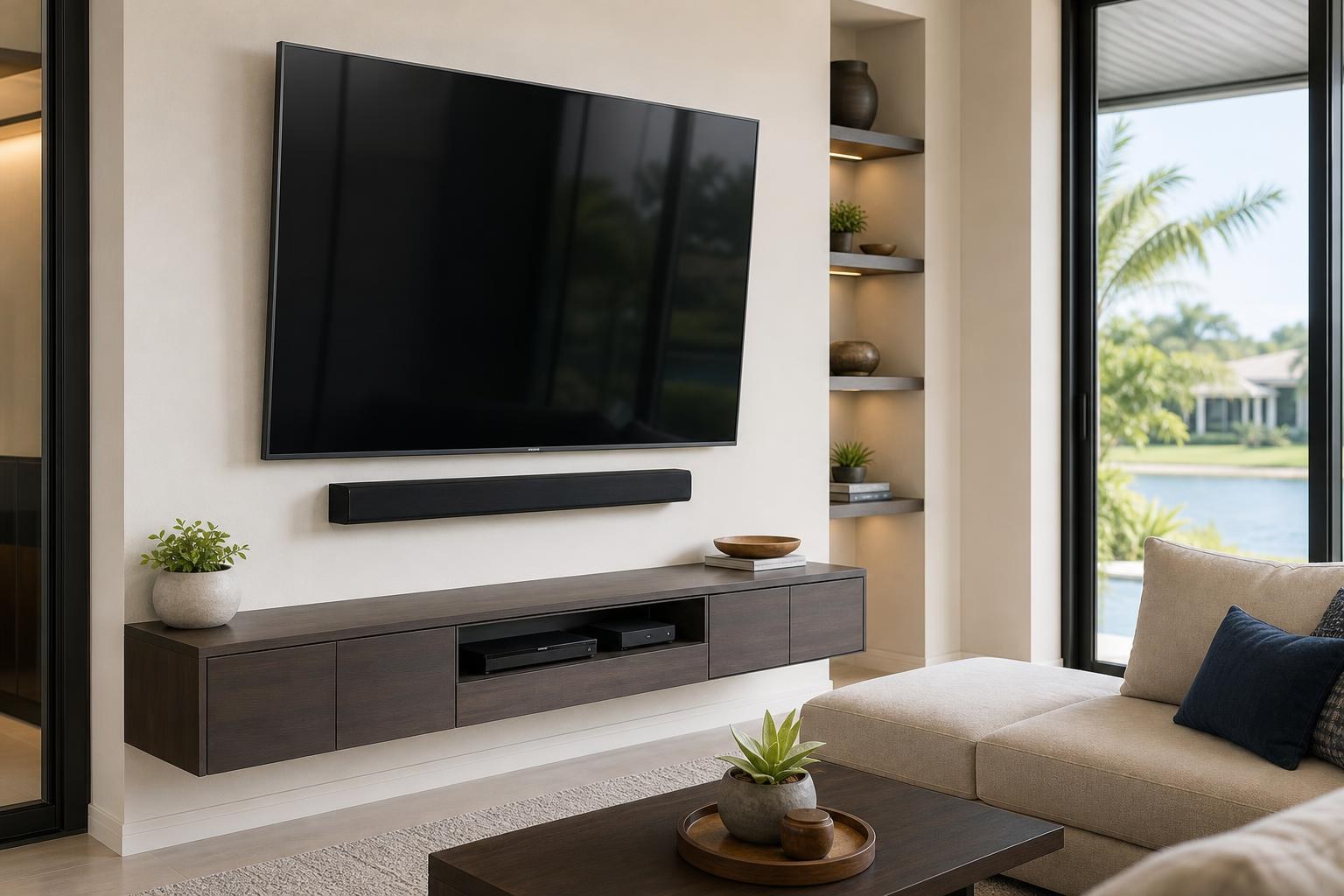
How Room Layout Changes TV-to-Soundbar Spacing: 3 Setups to Compare
November 5, 2026
A TV and soundbar can look perfectly coordinated from across the room yet become awkward in daily use. The soundbar may block the TV’s lower edge, cover a remote sensor, sit too far below the screen, or appear misaligned when the TV tilts toward the seating area.
That is why TV-to-soundbar spacing should be planned around the entire room—not treated as one universal measurement. The right relationship changes depending on whether the soundbar is mounted, placed on furniture, or paired with a screen that moves.
Before booking TV Mounting Services, compare these three common layouts and the practical differences each one creates.
TV-to-soundbar spacing is a three-dimensional decision
Homeowners often evaluate the space between a TV and soundbar by looking straight at the wall. That front view matters, but it is only one part of the layout.
The TV may project away from the wall on its mount. A mounted soundbar may sit closer to the wall or farther into the room. A console can position a freestanding soundbar several inches in front of the screen. Once those depths differ, the two components can look closer or farther apart depending on where someone is seated.
The plan should account for the screen’s lower edge, the soundbar’s height and depth, the TV’s remote sensor, any upward-facing speakers, mount movement, and the routes used for media cables. Manufacturer guidance for both products also matters, particularly where a soundbar needs unobstructed space around specific drivers.
Layout 1: The soundbar is mounted below a fixed TV
This arrangement usually creates the most visually unified TV wall. Because both pieces are attached to the wall, their horizontal alignment and visible gap can be coordinated as one composition.
A relatively close relationship often looks intentional, but “close” should not mean crowded. The soundbar should not cover the screen, interfere with a TV sensor, restrict access to controls, or appear to touch the TV frame. Enough separation is also needed to keep the two components visually distinct.
The width of the soundbar changes the result. A compact bar centered under a large TV can tolerate more negative space around it. A bar nearly as wide as the TV tends to look better when its centerline and edges are carefully coordinated with the screen.
This layout works especially well when the homeowner wants a clean wall with minimal equipment on the furniture below. It can also simplify the visual route of HDMI and other media cables when cable concealment is planned with the mounting positions.
Layout 2: The soundbar sits on a media console
Placing the soundbar on furniture changes the spacing question. Instead of selecting a wall gap alone, the plan must coordinate the TV height with the console height, soundbar height, and viewing position.
A tall console or tall soundbar can push the TV higher than expected if the screen is mounted afterward without considering both pieces. Conversely, a low console may leave an oversized area of blank wall between the soundbar and TV. That distance can make the audio and picture feel visually disconnected even when they function together.
The soundbar’s position on the furniture matters too. It should not cover the TV’s lower edge from the primary seats or compete with decorative objects, streaming devices, a Blu-ray player, or other equipment. If the furniture is not yet assembled, coordinating Furniture Assembly Ocala with the TV layout can help establish the final furniture dimensions before the screen position is settled.
This setup can be a practical choice when the room may change later or when the homeowner wants the soundbar accessible without adding another wall-mounted component. The tradeoff is that furniture placement now determines part of the TV-to-soundbar relationship.
Layout 3: The TV tilts while the soundbar stays fixed
A tilting TV introduces a depth and angle difference that is easy to miss during initial planning. When the bottom of the screen angles away from the wall, it may move visually closer to a wall-mounted soundbar. From a low sofa or recliner, the apparent gap can become smaller than it looked when the TV was flat.
The mount’s intended tilt range therefore needs to be considered before the soundbar position is finalized. The goal is to preserve comfortable separation through the screen’s expected movement—not only when everything is resting flat against the wall.
There is also an alignment choice. A soundbar mounted independently to the wall remains level and stationary while the screen moves. A compatible soundbar arrangement that moves with the TV can preserve a more consistent visual relationship, but compatibility depends on the TV, mount, soundbar, and selected mounting components.
This distinction is especially relevant in rooms where the TV is mounted above a taller console or viewed from reclining furniture. Residents planning TV Mounting The Villages may want to discuss the primary seated eye line and expected tilt rather than choosing placement from a standing position.
Which room details should influence the final gap?
Before deciding whether the soundbar belongs on the wall or furniture, review the parts of the room that cannot be judged from product dimensions alone:
- Primary seating: A gap that looks balanced while standing may feel different from a sofa, bed, or recliner.
- Furniture height: The console and soundbar together establish the minimum clear area below the screen.
- Screen movement: Tilting or swiveling changes the screen’s depth and apparent alignment.
- Soundbar design: Driver placement, controls, sensors, and manufacturer clearances can affect positioning.
- Device arrangement: Streaming devices, media players, remotes, and game systems need an organized location and usable cable path.
- Visual balance: Shelves, artwork, and floating furniture can make a technically workable gap look too compressed or too open.
In an open room, also evaluate the TV wall from nearby dining or kitchen areas. A soundbar that appears centered from the main sofa may seem offset when viewed from another frequently used zone. For homes with angled seating or multi-use rooms, TV Mounting Gainesville planning can include the screen position, soundbar, devices, and furniture as one connected layout.
Common spacing mistakes that lead to a second appointment
One common mistake is mounting the TV first and selecting the soundbar later. The new bar may be taller, deeper, or wider than expected, leaving an uncomfortable gap or interfering with the intended screen angle.
Another is measuring an unfinished console. Feet, a top panel, or other assembled components may change its final height. Decorative items placed in front of the TV can create additional visual clutter or block parts of the setup.
It is also easy to focus on the two main components while overlooking cable ends, device access, and remote behavior. A polished entertainment wall should remain practical after the streaming device, media player, soundbar connection, and control settings are added.
What should you provide when requesting a quote?
Useful photos include a straight view of the TV wall and a side view showing the seating position. Provide the TV and soundbar model information when available, along with the mount type, console dimensions, and whether the screen needs to tilt or swivel.
Also mention whether the project includes media-cable concealment, streaming-device setup, Blu-ray hookup, home entertainment programming, floating shelves, or media-furniture assembly. A complete scope helps the finished spacing support the whole room instead of solving only the gap between two products.
TV Mounting Ocala serves homeowners and residents across Marion, Orange, Alachua, Sumter, and Citrus counties. If you are uncertain which layout fits your room, you can contact the team with your setup details or get an instant quote and select the services needed for your TV, soundbar, devices, cables, and media furniture. You can also call (352) 462-1913.
Ready to Get the Setup Off Your To-Do List?
Whether you are planning a new TV, soundbar, streaming setup, floating entertainment center, media furniture, pictures, mirrors, shelves, or another related mounting project, TV Mounting Ocala can help you turn the plan into a clean finished setup.
TV Mounting Ocala
(352) 462-1913
Project details, equipment, wall conditions, compatibility, availability, and final pricing can vary. Confirm your exact scope and quote before booking.