
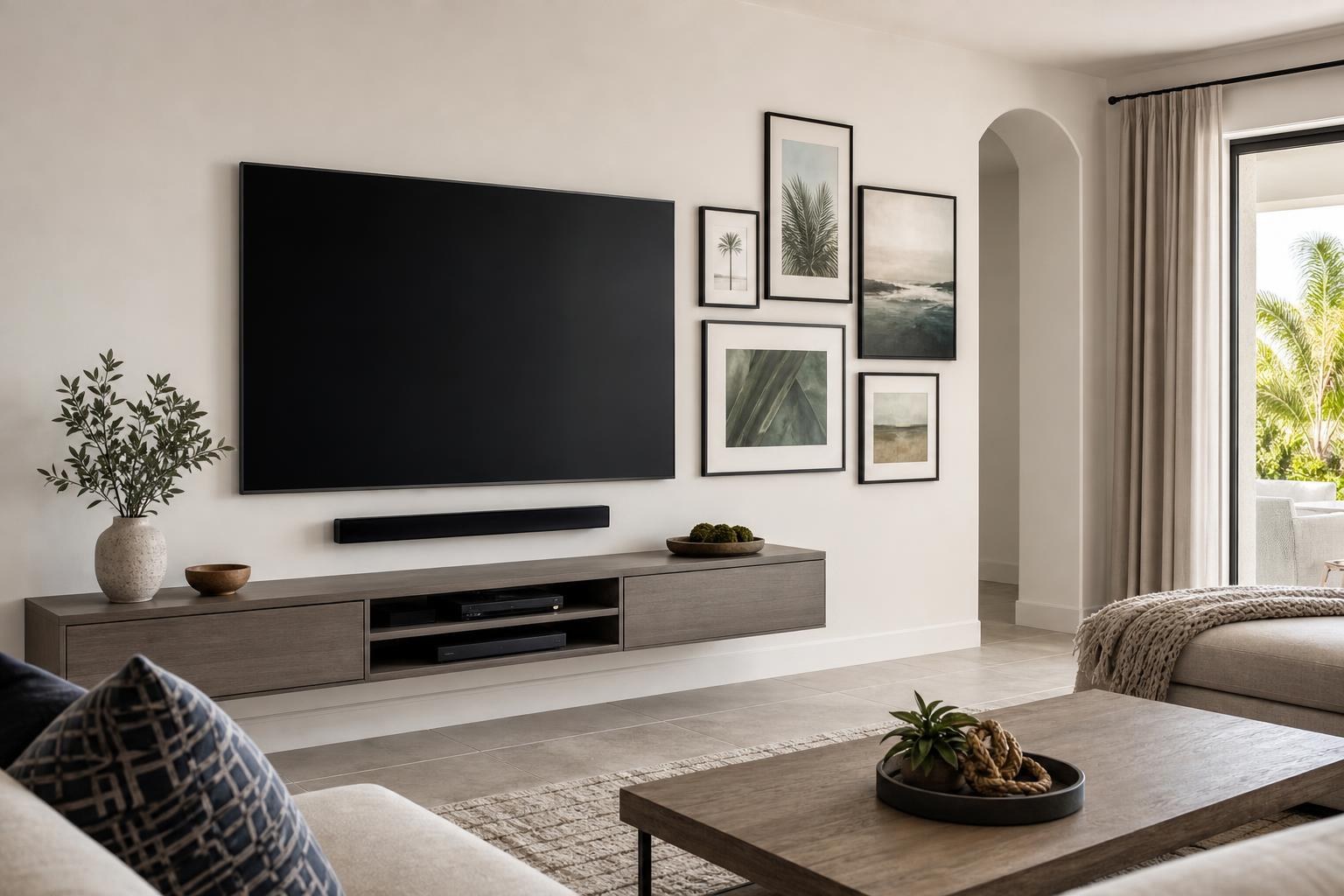
Asymmetrical Picture Wall Beside a Mounted TV: Plan Spacing, Balance, and Screen Access
October 27, 2026
You want to add framed art beside your mounted TV, but every arrangement seems to create a new problem. The pictures may feel disconnected from the media console, crowd the screen, catch distracting glare, or block the path of a swiveling TV.
An asymmetrical picture wall can solve the visual imbalance without forcing identical frames onto both sides of the screen. The key is to treat the TV, soundbar, furniture, and art as one composition—not as separate items competing for wall space.
For Central Florida homeowners planning both TV mounting and picture hanging, these decisions are easiest to make before the final positions are established. Here is what to consider before requesting a quote or booking the work.
Start With the TV Wall’s Fixed Visual Anchors
Before choosing where the first frame belongs, identify the objects that already define the wall. The TV is usually the strongest visual anchor, but it is not the only one. A media console, floating entertainment center, soundbar, doorway, window, or tall piece of furniture can affect how the arrangement feels.
Use the full installation as your reference. If the TV is centered over a console, the combined TV-and-furniture grouping creates a strong central axis. Your art can be asymmetrical without making that axis look accidental. If the console sits slightly off-center because of the room layout, the pictures may help visually connect the installation to the surrounding wall.
Homeowners booking TV Mounting Ocala can coordinate the screen position with picture hanging, soundbar placement, cable organization, and related wall-mounted items instead of trying to correct the composition afterward.
Build an Asymmetrical Group That Still Feels Intentional
Asymmetry does not mean random placement. A successful arrangement usually has a clear visual boundary, repeated spacing, and some relationship among frame colors, artwork, or proportions.
Rather than mirroring the same frames on both sides of the TV, consider creating one concentrated picture grouping beside the screen. A second, smaller visual element—such as a single frame, plant, or furniture detail—can provide balance elsewhere without producing a perfectly matched layout.
Several planning choices can make the group feel cohesive:
- Keep the gaps between neighboring frames visually consistent, even when the frames have different dimensions.
- Repeat at least one characteristic, such as frame finish, mat color, artwork palette, or orientation.
- Give the collection a recognizable outer shape rather than allowing isolated frames to drift toward the ceiling or doorway.
- Let one larger piece lead the group, with smaller frames supporting it instead of competing equally for attention.
The finished arrangement should look connected from normal seating positions, not only when viewed straight on from a few feet away.
Leave Enough Breathing Room Around the Screen
A picture wall can be visually balanced and still sit too close to the TV. Dark frames near a bright screen can become distracting during movies, while light artwork may reflect on glossy displays. Frames positioned close to the screen edge can also make a large TV feel squeezed into the wall.
There is no single spacing measurement that works for every room. A slim frame beside a fixed TV behaves differently from a deep shadow box beside a screen on a full-motion mount. Screen size, frame depth, wall width, and typical viewing distance all matter.
Plan a clear visual buffer between the television and the nearest frame. That buffer should remain apparent when the art is viewed as a group. If the screen can extend, tilt, or swivel, evaluate the clearance using its intended viewing positions rather than judging the layout only while the TV is flat against the wall.
Account for Swivel, Tilt, and Screen Movement
A full-motion TV changes the usable area around it. When pulled forward and angled toward a dining area or adjoining room, the screen may overlap the sightline to nearby artwork. Its edge or mount movement could also come closer to a projecting frame than expected.
Before finalizing the picture arrangement, consider:
- The direction in which the screen will turn most often
- How far it needs to angle for secondary seating
- Whether thick frames or canvas edges project into that movement zone
- Whether a nearby soundbar moves with the TV or remains in a fixed position
- How the arrangement looks with the screen both stored and extended
This is especially useful in open living and dining spaces common around Ocala and The Villages. If the television needs to serve more than one seating zone, a professional planning TV Mounting The Villages can help account for the complete wall composition before items are mounted.
Align the Art With Furniture, Not Just the TV
A common mistake is aligning every frame to the top or middle of the television while ignoring the furniture below. The TV may be the focal point, but the media console gives the wall its visual base.
Look at the console’s outer edges, cabinet divisions, open shelving, and nearby furniture. A picture grouping can begin near one edge of the console, extend modestly beyond it, or visually bridge the space between the media zone and an adjacent chair. What matters is that the arrangement appears connected to something below it.
If your entertainment center still needs assembly, settle its size and final position before confirming the artwork layout. Furniture Assembly Ocala can be coordinated with entertainment-center placement, furniture anchoring, and the broader TV-wall setup. This prevents an assembled console from revealing that the planned picture group is too wide, too low, or centered on the wrong reference point.
Check Daylight, Lamps, and Screen Glare
Framed art with glass can introduce reflections that are not obvious when the room is dim. In a bright Central Florida living room, windows, sliding doors, and lamps can appear in both the art and the television. The result may be a wall that looks polished at one time of day but distracting at another.
Observe the wall in morning, afternoon, and evening conditions when possible. Consider whether a bright frame surface creates a noticeable reflection beside dark movie scenes. Also check whether the TV’s angle toward secondary seating increases glare from the framed artwork or nearby windows.
This does not mean every surface must be matte. It means frame finish, glazing, and screen angle should be considered together. Homeowners planning installations in Orange County can use TV Mounting Orlando to coordinate the television, soundbar, media devices, and surrounding wall items as one finished setup.
Protect Future Access to Cables and Devices
The best-looking arrangement can become inconvenient if it blocks access needed later. Streaming devices, Blu-ray players, soundbar connections, and other media equipment may require occasional adjustments or replacement. Cable routes may also need to remain reachable without removing multiple frames.
Before placing artwork, identify where device connections are accessed, where media cables travel, and whether the television must move forward for service. Avoid using picture frames to disguise areas that need practical access. A clean wall should still support future equipment changes.
If you expect to add a game system, replace a soundbar, or move streaming equipment into a floating entertainment center, mention that when reviewing TV mounting services. Planning for likely changes now can preserve the arrangement later.
What to Share When Requesting a Quote
Clear room information helps define whether you need TV mounting, picture hanging, furniture assembly, or a coordinated appointment. Useful details include the TV size, mount style, number and approximate sizes of frames, media-furniture dimensions, soundbar location, and devices that need to remain accessible.
Photos of the full wall and surrounding room are especially helpful. Include the console, windows, doors, seating direction, and any existing wall-mounted items rather than sending only a close-up of the TV area.
TV Mounting Ocala serves Marion, Orange, Alachua, Sumter, and Citrus counties with TV setup, soundbar mounting and setup, media-device hookup, cable concealment, furniture assembly, picture hanging, and related services. To plan your TV wall and asymmetrical picture arrangement together, get an instant quote online or call (352) 462-1913.
Ready to Get the Setup Off Your To-Do List?
Whether you are planning a new TV, soundbar, streaming setup, floating entertainment center, media furniture, pictures, mirrors, shelves, or another related mounting project, TV Mounting Ocala can help you turn the plan into a clean finished setup.
TV Mounting Ocala
(352) 462-1913
Project details, equipment, wall conditions, compatibility, availability, and final pricing can vary. Confirm your exact scope and quote before booking.