
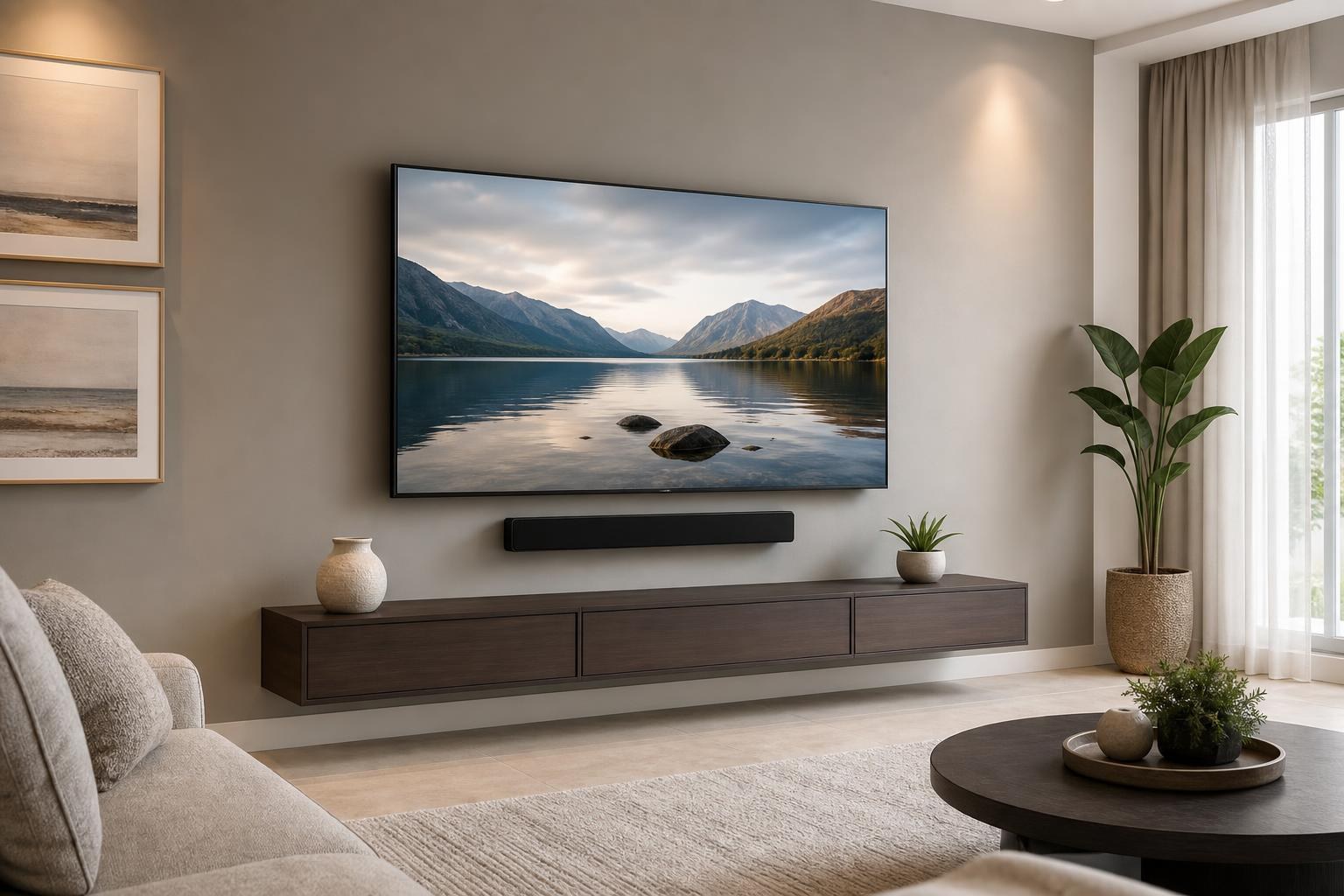
Mount the Soundbar or Place It on the Console? How to Choose for Your TV Setup
October 2, 2026
Your TV is mounted, the media console is in place, and the soundbar could work in either location. Should it be attached to the wall directly below the screen, or should it rest on the console?
Both arrangements can look polished and perform well. The better choice depends on how the TV moves, where the soundbar’s controls and sensors are located, how visible the media cables will be, and whether the console needs to hold other devices. For Marion County homeowners planning a complete entertainment wall, this decision is best made before the final TV and furniture positions are set.
The quick comparison: mounted soundbar vs. console placement
A wall-mounted soundbar usually creates the most visually unified arrangement. The TV and speaker read as one centered system, and the console surface remains open. This can be especially effective with a floating console or a minimal media wall.
Console placement offers more flexibility. The soundbar can be repositioned without changing the wall arrangement, and access to its ports may be easier. It can also be a practical choice when the console is already at an appropriate height and has enough depth for the soundbar.
- Choose wall mounting when you want strong visual alignment, a clear console surface, and coordinated movement with an adjustable TV mount.
- Choose console placement when flexibility, easy device access, or future furniture changes are more important.
The decision becomes more nuanced once you consider the exact TV mount, soundbar design, remote behavior, cable route, and furniture dimensions.
Which option creates better alignment?
A soundbar mounted directly below the TV can create a clean centerline. The screen and speaker stay visually connected, which helps prevent the entertainment wall from looking like several unrelated pieces. This is particularly useful when the TV is wider than the console or when the console is intentionally offset by nearby shelving or room architecture.
Console placement can still look balanced, but it depends more heavily on the furniture. A soundbar may appear misplaced if the console is not centered under the screen, if the top is crowded, or if the speaker sits unusually far below the TV. A tall decorative object or stacked media device can also interrupt the visual relationship between the screen and speaker.
Before choosing, compare the center of the TV, the center of the intended soundbar position, and the center of the console. They do not always need to match perfectly, but the overall composition should look intentional from the room’s primary seating area.
Will the soundbar interfere with remote response?
Remote response is one of the most important practical considerations. Depending on the television and speaker designs, a soundbar placed on a console may sit in front of the TV’s remote sensor. This is more likely when the TV has a low-profile stand or the console top is close to the bottom edge of the screen.
A blocked sensor can result in inconsistent commands or force you to hold the remote at an awkward angle. Moving the soundbar forward or sideways may help in some arrangements, but that can weaken the clean, centered appearance homeowners usually want.
Mounting the soundbar below a wall-mounted TV often gives both components clearer separation. However, placement still needs to account for the soundbar’s own controls, indicator lights, upward-facing speakers, and remote sensor. The soundbar should not be tucked so tightly against another surface that key features become hard to see or use.
A professional setup can include checking basic remote response and coordinating TV, soundbar, and media-device control. The available TV mounting services can also be paired with home entertainment programming when the goal is a simpler everyday experience rather than several disconnected remotes.
Which placement gives you cleaner-looking cables?
Wall mounting often provides the cleanest visual path because the soundbar’s media cables can be organized as part of the TV-wall plan. The TV and soundbar connections can follow a coordinated route rather than crossing the gap between the screen and furniture in separate directions.
This advantage depends on planning. A soundbar added after the TV is mounted may leave a visible cable loop, an awkward gap, or a connection that pulls to one side. It helps to identify the soundbar model, port locations, connected devices, and intended cable path before the wall layout is finalized.
A console can conceal some cable slack behind the furniture, but short sections may remain visible between the TV, soundbar, and console. The result can still look neat when the components are aligned and the media cables are organized rather than bundled loosely across the console top.
If a floating cabinet or new media console is part of the project, combining soundbar planning with Furniture Assembly Ocala can help the TV, speaker, and furniture function as one arrangement. This is often more effective than deciding each component’s position separately.
Does the TV move on an adjustable mount?
A fixed TV generally makes either soundbar position straightforward. The screen remains centered, so a wall-mounted speaker or console-based speaker can stay aligned with it.
An articulating or swivel mount changes the decision. When the TV is pulled forward or angled toward another seating area, a soundbar fixed to the wall remains behind. The picture may face the viewer while the speaker still points straight into the room. The setup can also look disconnected when the screen moves away from the soundbar.
In these rooms, attaching the soundbar so it moves in coordination with the TV may provide more consistent alignment. Compatibility depends on the TV, mount, soundbar, and attachment arrangement, so it should be reviewed as a complete system rather than assumed.
A console-based soundbar also stays in one position when the TV turns. That may be acceptable for occasional screen adjustments, but homeowners who regularly angle the TV toward a dining area, kitchen, or secondary seating zone should consider how often the sound and picture will point in different directions.
How console size and daily use affect the choice
Placing the soundbar on furniture uses valuable surface area. Measure more than its width: the console also needs enough depth, and the speaker should not be crowded by the TV stand, decorative objects, streaming devices, or a Blu-ray player.
Consider what the console must handle every day:
- Media devices that need convenient remote response
- Game systems or disc players that require access
- Decor that could obstruct the front or top of the soundbar
- Cabinet doors or drawers that should open without interference
- Future devices that may need a practical home
If the console is narrow, floating, or intended to remain visually minimal, mounting the soundbar can preserve usable space. If the furniture is deep and designed around media equipment, keeping the soundbar on top may offer welcome flexibility.
When wall-mounted soundbars make the most sense
Wall mounting is often the stronger choice when the entertainment wall has a streamlined design, the console surface needs to stay clear, or the soundbar should visually follow the TV. It can also make sense when a low console position would leave too much empty space between the screen and speaker.
Homeowners often favor this arrangement for floating entertainment centers, bedrooms with limited furniture, and living rooms where the mounted TV is the clear focal point. A coordinated installation by TV Mounting Ocala can include TV placement, soundbar mounting and setup, media-cable organization, and device connection.
When console placement is the practical choice
A console-based soundbar can be preferable when the room arrangement may change, the homeowner expects to replace the furniture, or the speaker needs frequent port access. It also avoids visually committing the wall to a specific soundbar width and shape.
This option works best when the console is centered, stable, appropriately sized, and low enough that the soundbar will not interfere with the screen or remote response. It should look like an intentional part of the media arrangement—not an accessory squeezed in after every other component was positioned.
What to decide before requesting a quote
Before booking, note the TV and soundbar models, the type of TV mount, the console dimensions, and the devices that need to be connected. Mention whether the television will regularly swivel and whether you want the soundbar to move with it. Photos of the wall, furniture, and existing components can also clarify the intended layout.
TV Mounting Ocala serves homeowners and property residents throughout Marion County and other parts of Central Florida with TV mounting, soundbar setup, media-device hookup, cable organization, entertainment programming, and related furniture installation. You can review the options and get an instant quote online.
If you are unsure which soundbar position fits your equipment, use the contact page or call (352) 462-1913. A little planning before the appointment can produce a cleaner wall, more reliable controls, and a TV-and-soundbar arrangement that works naturally from the way you use the room.
Serving another priority local market: TV Mounting The Villages.
Ready to Get the Setup Off Your To-Do List?
Whether you are planning a new TV, soundbar, streaming setup, floating entertainment center, media furniture, pictures, mirrors, shelves, or another related mounting project, TV Mounting Ocala can help you turn the plan into a clean finished setup.
TV Mounting Ocala
(352) 462-1913
Project details, equipment, wall conditions, compatibility, availability, and final pricing can vary. Confirm your exact scope and quote before booking.